Explore our industrial-grade Ethernet and LoRaWAN environmental data loggers designed for continuous museum showcase monitoring.
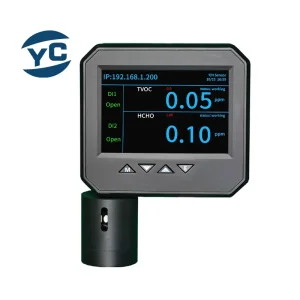
High-precision Ethernet-based data logger monitoring temperature, relative humidity, TVOC, and Formaldehyde (HCHO) for integrated museum air quality preservation.
View Details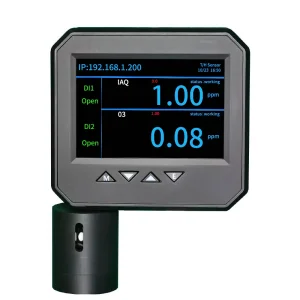
Advanced indoor air quality monitor featuring specialized ozone (O₃) electrochemical sensors alongside precise temperature and humidity monitoring.
View Details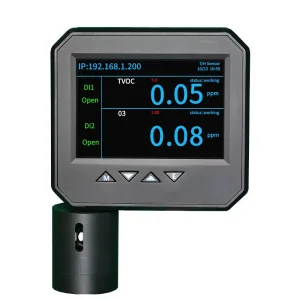
Versatile multi-parameter sensor offering multi-channel data acquisition, custom firmware options, and dynamic environmental monitoring capabilities.
View Details
Ethernet integrated sensor featuring PoE capability, providing highly secure and stable Modbus TCP networks for archival microclimate logging.
View Details
Robust industrial-grade sensor platform certified to comply with strict international conservation protocols for tracking corrosive volatile gases.
View Details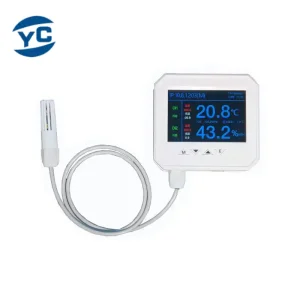
Equipped with decoupled optional probes for targeted microclimate tracking inside sealed exhibit showcases and storage display cases.
View Details
Designed for wholesale integration, this unit delivers comprehensive tracking of volatile organic compounds and ambient ozone concentrations.
View Details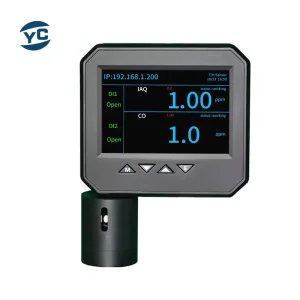
Engineered for combined carbon monoxide monitoring and general indoor air quality tracking with ultra-low thermal drift sensors.
View DetailsPreventive conservation in museums, libraries, and historical archives requires strict control of environmental variables. Fluctuations in relative humidity (RH) and temperature are primary drivers of organic degradation. High relative humidity triggers hygroscopic swelling, microbial growth, and chemical hydrolysis of paper and textiles. Conversely, drop-offs in moisture content lead to mechanical shrinkage, brittleness, and micro-fractures in varnishes, wood structures, and paint layers.
Under the Arrhenius equation, biological and chemical decay processes double in velocity with every 10°C increase in temperature. This physical law demands the deployment of high-stability sensor systems that maintain exceptional calibration consistency over long cycles. To fulfill the strict compliance targets defined by BS EN 15757 and ISO 11799, institutions must secure sensor architectures that combine multi-sensor drift compensation with fail-safe digital communication protocols like Power-over-Ethernet (PoE) and Modbus TCP.
Beijing Yingchuanglihe (YCLI) addresses these complex demands by engineering data loggers that leverage industry-leading Swiss and German sensing chips. Our environmental monitoring platforms integrate multi-parameter gas arrays (detecting TVOC, Formaldehyde, Ozone, SO₂, and NO₂) directly with core temperature and relative humidity metrics. This holistic design prevents microclimatic degradation, preserving delicate heritage artifacts for future generations.
Established in 2007, Beijing Yingchuanglihe Electronic Technology Co., Ltd. (YCLI) is a premier manufacturer of high-precision environmental sensors.
2007: Founded and pioneered early IP-based environmental monitoring software and hardware.
2009: Partnered with Switzerland's COMLAB to develop high-stability sensors for national high-speed rail lines.
2015: Collaborated with search leader Baidu to deploy smart environment monitoring at their Yangquan Data Center.
2021: Engineered and supplied edge-computing road test enclosures for Beijing's autonomous driving initiative.
2024: Co-established specialized satellite telemetry and smart grid system divisions with Beijing's top technical universities.
Why international conservators, engineering distributors, and IoT integrators choose China's leading sensor factory.
Operating within China's Silicon Valley networks allows YCLI to Source raw microchips, PCB components, high-precision injection molds, and metal probes with extreme speed and lower material costs. Our localized ecosystem ensures that custom modifications for cables, casing shapes, and connector types are engineered, tested, and shipped in a fraction of the time compared to Western competitors.
Before leaving our Beijing factory, every single environmental monitoring device undergoes an exhaustive thermal aging and cross-calibration procedure. Using specialized temperature-controlled calibration ovens, we match data channels across different communication configurations (Ethernet, WiFi, LoRaWAN) to confirm reading stability, assuring museum operators that readings will not drift over time.
Our R&D team builds software architectures with deep system compatibility. Whether integrating sensors into a modern BACnet-based building automation network, connecting to standard SNMP infrastructure, or piping telemetry straight to a cloud database via REST API or MQTT client, our firmware is designed to connect instantly with zero complex programming required.
Complete hardware-to-software monitoring topologies customized for historic properties, preservation environments, and large-scale industrial warehouses.

Underground facilities require constant protection from moisture buildup and structural leaks. Our remote-probe sensor arrays monitor tight cracks and air ducts, delivering real-time alerts if local relative humidity triggers condensation risk.

Sealed glass showcases are vulnerable to localized off-gassing from adhesives, wood frames, and textile backings. APEM multi-parameter devices monitor volatile organic compounds (TVOCs) and ozone alongside temperature to prevent artifact decay.

Research and restoration labs demand stable pressure differentials to avoid cross-contamination. Our high-precision APEM-5930P series actively tracks ambient barometric pressure, temperature, and relative humidity.
How we support international architectural planners, government cultural divisions, and systems integrators.
We support third-party calibration certifications, supplying detailed reference testing data matching NIST-traceable standards for demanding cultural institution installations.
Request customized external probe lengths (ranging from 1 to 5 meters) with armored shielding to easily run telemetry through complex, historic interior wall designs.
Tiered pricing models designed for massive infrastructure and municipal museum renovations, offering stable cost advantages directly from our factory floor.
Guaranteed 8-hour technical response times, detailed engineering manuals, API documentation, and expert assistance from our systems integration team.
Answers to crucial engineering and deployment questions from integration architects and facility conservators.
Complete your environmental monitoring system with our full catalog of high-performance data loggers and multi-parameter gateways.
Precision data logger combining indoor air quality tracking and carbon monoxide sensors with reliable Ethernet data transmission.
View Details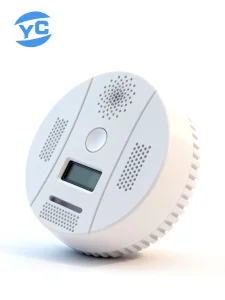
Ultra-low-power LoRaWAN environmental sensor designed for long-range wireless tracking in large historical properties and galleries.
View Details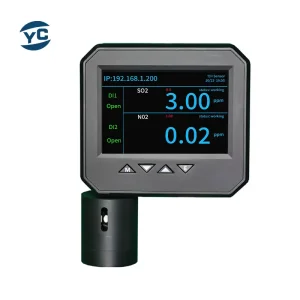
Specialized multi-gas telemetry system built for active tracking of corrosive sulfur dioxide (SO₂) and nitrogen dioxide (NO₂) levels.
View Details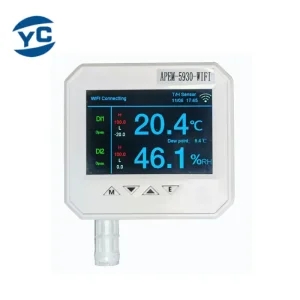
Wired and wireless dual-mode sensor designed for flexible deployment in office complexes, public institutions, and archives.
View Details
Fully certified Ethernet monitor featuring remote plug-in probes, ideal for tight installation areas inside exhibition displays.
View Details
High-precision sensor system developed for tracking sulfur dioxide and nitrogen oxides to protect heritage artifacts from acid decay.
View Details
Reliable air quality data logger designed for integration with centralized HVAC systems in museums, libraries, and galleries.
View Details
Commercial-grade multi-gas monitoring station offering robust Ethernet connectivity and high-accuracy measurements for archival spaces.
View Details YCLH Sensor