Direct from China's OEM/ODM Intelligent Production Lines. Real-time Multi-Parameter Industrial-Grade Telemetry Solutions.
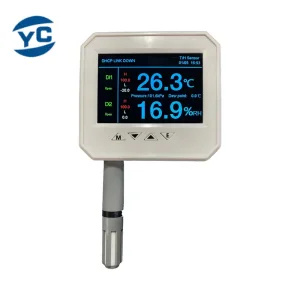
The Evolution of Power-Over-Ethernet (PoE) Sensors in Next-Generation Cyber-Physical Systems (CPS)
Modern industrial architectures are moving away from traditional local battery-powered telemetry nodes. In high-density settings like hyperscale cloud data centers and cleanrooms, battery dependency causes maintenance failures, while local electrical installations increase system complexity and risks. Standardized Power over Ethernet (IEEE 802.3af/at) offers a solution by combining gigabit-grade data transfer with continuous, safe low-voltage DC power delivery over a single Cat5e/Cat6 channel.
This technical shift has enabled the development of China-sourced PoE web sensors. These devices use advanced ARM Cortex-M microcontrollers to handle data conversions right at the network edge. Instead of sending raw analog signals, which are prone to electrical interference, modern web sensors convert and process measurements locally, outputting calculated dew points, absolute barometric pressure, and calibrated pollutant levels directly into Modbus TCP registers or SNMP v2c/v3 MIB structures.
Looking ahead, the integration of AI-driven anomaly detection directly within the sensor firmware is set to transform environmental monitoring. Future revisions of the APEM-5930 series will feature on-device machine learning models capable of predicting sensor drift, identifying micro-thermal anomalies, and dynamically managing sampling rates based on environmental volatility, further reducing bandwidth overhead for global IT frameworks.
18+ Years of Verified Expertise in Industrial Environment Sensing & High-Tech System Engineering
Beijing Yingchuanglihe Electronic Technology Co., Ltd. is an industry-leading environmental telemetry manufacturer. Established in 2007 and headquartered in Beijing, our state-of-the-art production base covers over 1,500 square meters. With a specialized workforce of over 100 professionals and certified clean calibration facilities, we combine rigorous testing protocols with German and Swiss core sensing elements to deliver reliable environmental monitoring sensors.
Company founded. Developed first-generation intelligent environmental monitoring terminals based on TCP/IP network protocol alongside initial environmental monitoring software suites.
Partnered with Mocha Software to launch the TH-5939 series of network management environmental monitoring units supporting SNMP protocol natively.
Collaborated with Switzerland's COMLAB to develop the highly protective TH-5869 Ethernet environmental monitoring device, successfully deployed across state-level high-speed rail lines (Beijing-Kowloon, Beijing-Shanghai, Wuhan-Guangzhou railway links).
Collaborated with Founder Technology to deploy the APEM-6100, marking our early adoption and standard implementation of Power over Ethernet (PoE) in China's industrial monitoring space.
Formed strategic production alliances with Foxconn, establishing our sensors as default industry standards for localized workshop and clean manufacturing environments.
Partnered with Baidu to deploy the advanced APEM-5900 intelligent network terminal at the massive Baidu Yangquan Data Center, with simultaneously upgraded multi-parameter software integrations.
Launched smart solutions framework systems across diverse sectors, migrating systems horizontally from standard server halls into expansive logistics operations.
Introduced the integrated outdoor cabinet monitoring system, deployed in key infrastructure projects with Huawei and China Merchants Huaruan ETC expressways.
Directly engineered and manufactured the high-reliability environmental core inside Beijing's high-level autonomous driving road-test integration boxes and edge computing gateways.
Supported construction of key intelligent computing centers with targeted thermal, humidity, and atmospheric tracking hardware.
Co-founded the high-precision Beidou deformation monitoring team with Beijing University of Civil Engineering and Architecture, integrated smart monitoring with Beijing Enterprises Water Group, and officially obtained Internet Data Center (IDC) qualification standards.
Engineered Architectures for High-Stakes Environments & Critical Infrastructure
Eliminate thermal hotspots and tracking lag inside modern server rooms. The APEM-5930 range delivers rapid measurements directly to building management protocols, protecting critical computing equipment.
Maintains strict environmental control in GMP-certified laboratories. Our sensors provide real-time pressure differential, temperature, and relative humidity monitoring to protect manufacturing integrity.
Preserve organic materials, archival papers, and military supplies. These high-precision units monitor humidity and chemical pollutants to prevent long-term environmental degradation.
Combined with Beidou spatial telemetry, our smart utility integrations offer real-time detection of sewer gases, water leaks, and deformation issues across municipal networks.
Scale, Speed, and Quality Assured by Advanced Industrial Production Facilities
Yingchuanglihe operates out of a modernized high-precision facility in Beijing, utilizing advanced automation and strict quality management workflows. By combining cost-effective local production with high-grade imported components (such as Swiss CMOSens® relative humidity chips and German industrial barometric modules), we deliver high reliability and performance at competitive prices.
Our production facilities feature multi-chamber environmental aging tunnels, automated computerized calibration, and strict electrical diagnostic setups. This allows us to guarantee reliable lead times and consistent product performance, while offering flexible customization options. Whether you need custom wire leads, specific sensor housings, or specialized communication protocols, our design-to-delivery workflows are built to support global deployment schedules.
| Workflow Stage | Standard Parameters & Control Quality |
|---|---|
| Core Componentry | Sensirion (Switzerland) & Bosch (Germany) chipsets |
| Calibration Traceability | Traceable to National Metrology Standards |
| Burn-in Protocol | 96-hour continuous thermal stress chamber testing |
| Environmental Certs | CE, FCC, RoHS, ISO9001 certified |
| R&D Turnaround | OEM prototype blueprints ready in 7 to 10 business days |
Seamless Integration with Modern IT and Building Management Frameworks
Supports Modbus TCP communication, mapping parameters to internal registers. Provides simple, secure data transmission for SCADA packages, PLC setups, and industrial control environments.
Full SNMP (Simple Network Management Protocol) integration with custom MIB files. Simplifies monitoring for IT teams using standard tools like PRTG, Zabbix, or solarwinds.
Supports direct connection to cloud systems via MQTT with JSON payloads. Our dual-stack WiFi and wired web sensors transmit raw values directly to AWS, Azure, or private IoT brokers.
In-depth Engineering Insights for System Architects and Procurement Directors
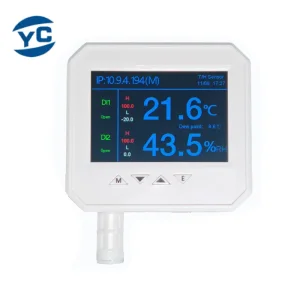
Our APEM-5930 sensors are designed to meet IEEE 802.3af standards, drawing power over standard Ethernet cables (Alternative A or B) through standard RJ45 ports. This design accepts input voltages between 12V and 48V DC, featuring isolation up to 1500V RMS to protect sensitive internal circuitry from network surges and electrical noise.
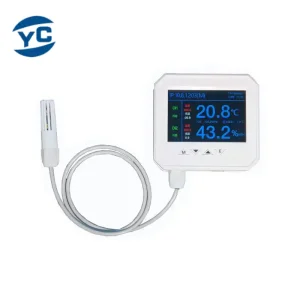
Yes, models like the APEM-5930E utilize an external, shielded cable (available in lengths from 1 to 5 meters) to separate the sensor probe from the main transmitter unit. This lets you place the network module outside of harsh environments, cleanrooms, or high-humidity spaces, keeping it safe while the probe monitors the target area.
Using Swiss digital sensing cores, our units achieve high long-term stability. The temperature sensor exhibits typical drift of less than <0.03°C/year, while the humidity sensor has a typical drift of less than <0.25% RH/year under normal operating conditions.
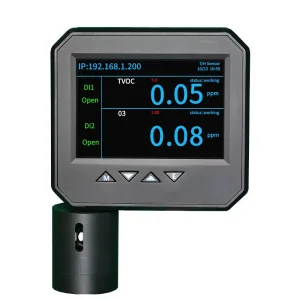
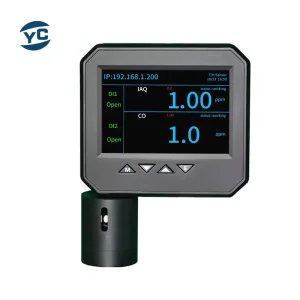
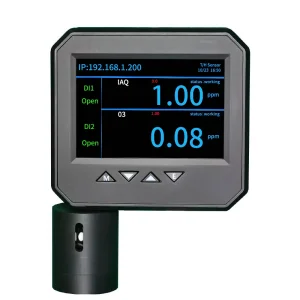
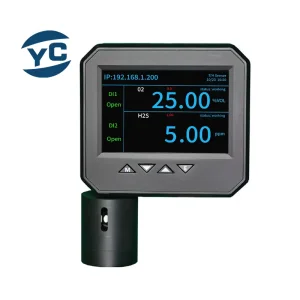
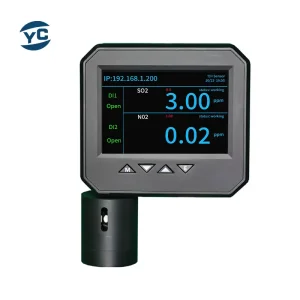
The APEM-5930G is a multi-parameter sensor that can monitor temperature, humidity, carbon monoxide (CO), ozone (O₃), TVOC, formaldehyde (HCHO), and sulfur dioxide (SO₂). It is configured using an internal web interface accessed through a standard web browser, where users can set alarm thresholds, IP configurations, and communication settings.
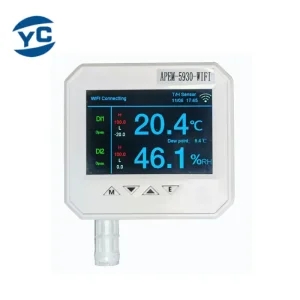
The APEM-5930W features dual-mode connectivity, combining a primary wired Ethernet port with 2.4GHz WiFi backup. If the physical Ethernet link drops, the device automatically fails over to the configured wireless network to maintain continuous data logging.
Yes, our firmware supports multi-point linear calibration adjustments. Authorized technicians can input offsets directly through the web interface or via Modbus TCP register writes, allowing users to match the sensors to on-site reference standards during routine maintenance.
Our web sensors include multi-level security features, such as password-protected configuration pages, configurable SNMP v3 access with encryption, and the ability to disable unused services (like HTTP or ping requests) to minimize the device's network attack surface.
Yes, our sensor housings are designed for industrial versatility, featuring built-in mounting flanges for wall installations as well as optional DIN-rail adapters for standard 35mm equipment racks.
The response time (T90) is typically less than 8 seconds for temperature variations and less than 5 seconds for relative humidity changes, facilitated by protective, high-diffusion sintered metal or mesh sensor caps.
Standard configuration orders of 100 to 500 units are typically shipped within 14 to 21 business days. Custom OEM/ODM requests (such as specialized wire runs, custom branding, or specific enclosures) require an additional 10 to 15 days for production validation.
Advanced Environmental Monitors with Integrated Gas Sensing and High Ingress Protection ratings
 YCLH Sensor