The global pharmaceutical supply chain functions under some of the most stringent regulatory environments on earth. Safe storage of medicines, vaccines, active ingredients, and clinical trial compounds demands continuous validation. Regulatory authorities worldwide, including the FDA (21 CFR Part 11), EMA (Annex 11), and the World Health Organization (WHO Annex 5 & 9), dictate that warehouses must be continuously mapped, monitored, and alarmed to prove storage parameters do not deviate from approved specifications.
"Temperature excursions are responsible for billions of dollars in pharmaceutical product losses annually. Precise, real-time environment monitoring is no longer just a regulatory box to check; it is a critical process safety shield."
Modern pharmaceutical warehouse monitoring systems must go beyond simple, manual recordings. Under Good Distribution Practices (GDP), storage facilities are required to perform detailed temperature mapping studies. Sensors must capture seasonal variance, high-traffic doorway influences, and HVAC cycling characteristics. The Mean Kinetic Temperature (MKT) must be calculated continuously to express the overall cumulative thermal stress a product experiences over time.
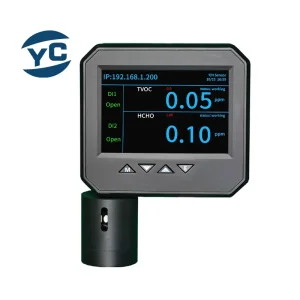
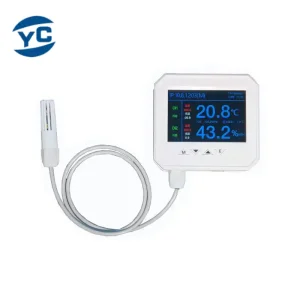
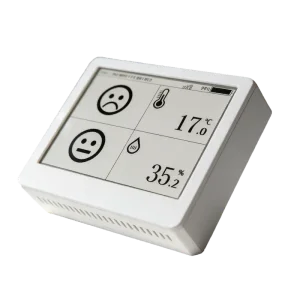
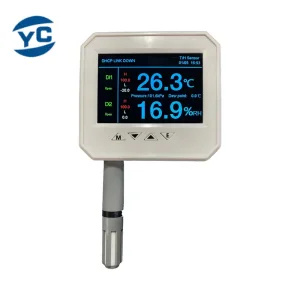
Yingchuanglihe's industrial-grade temperature and humidity sensors (such as the APEM-5930 Series) integrate directly with computerized monitoring platforms via standard protocols like Ethernet (TCP/IP) and Modbus. They supply clean, uninterrupted streams of data with precision down to ±0.2°C temperature accuracy and ±2% relative humidity accuracy. This high-density data feed provides engineers with the reliable dataset required to calculate compliant MKT values during both audit periods and standard operations.
For any system used in pharmaceutical monitoring, data integrity is paramount. Incomplete logs or unverifiable records will result in regulatory warnings (e.g., FDA Form 483). Under 21 CFR Part 11, monitoring equipment data logs must be tamper-proof, time-stamped, and archived in historical databases with complete audit trails.
By leveraging Power over Ethernet (PoE) sensors configured with internal local memory buffering, our clients ensure that even in the event of a network outage, data is stored locally on the sensor node and safely uploaded once connectivity is restored. This "zero-data-loss" architecture is highly valued by system integrators designing GAMP-compliant monitoring software solutions.
Beijing Yingchuanglihe was founded, pioneering some of the early TCP/IP based intelligent environmental monitoring terminals designed for automated industrial control systems.
Partnered with Switzerland's COMLAB to develop the TH-5869 specialized Ethernet environmental monitoring device, successfully deployed across major high-speed rail networks like the Beijing-Shanghai line.
In collaboration with Founder Technology, we developed and launched the APEM-6100, marking our entry into the early market-share for Power over Ethernet (PoE) environmental sensors.
Successfully integrated our next-generation APEM-5900 intelligent terminals inside Baidu's Yangquan Data Center, ensuring stable cooling and moisture profiles across massive computing modules.
Designed and deployed high-level edge computing gateways for autonomous driving road tests and intelligent compute center infrastructure, validating high-shock and high-temperature performance.
Formed major business divisions with Beijing Enterprises Water Group and co-founded Beidou high-precision pipeline deformation monitoring units, cementing industrial sensor dominance.
We utilize imported, high-precision chipsets from Germany and Switzerland (Sensirion cores) to guarantee long-term stability and NIST-traceable calibration profiles.
We customize probe lengths, wire casing materials, firmware communications (SNMP, BACnet, Modbus, MQTT), and outer shell branding on-demand.
Our five automated state-of-the-art production lines maintain massive quarterly volume capability with rigorous multi-step QC chambers before shipment.


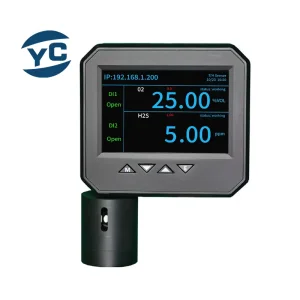
 YCLH Sensor