As modern cloud infrastructures, ultra-precision pharmaceutical cleanrooms, and automated smart factories continue to scale globally, environmental consistency has evolved from a basic operations checklist into a high-stakes competitive parameter. Historically, ambient temperature and humidity data points were monitored using isolated analog loops or unstable local wireless channels. However, these systems frequently suffered from signal degradation, battery depletion, high installation complexity, and severe maintenance overheads.
The introduction of Power over Ethernet (PoE) technology (governed by IEEE 802.3af/at standards) changed industrial environmental monitoring by combining low-voltage electrical power delivery and high-bandwidth data transmission over a single standard category cable (Cat5e/Cat6). Beijing Yingchuanglihe Electronic Technology Co., Ltd. (YCLISensors) has been at the forefront of this industrial hardware transition since 2007. By manufacturing precision custom PoE environmental sensors, we provide enterprises with a ruggedized hardware standard capable of directly integrating with modern IP networks, eliminating external power supplies, minimizing cable bulk, and delivering real-time environmental data directly to local SCADA networks, edge gateways, or centralized cloud instances.
Engineering a high-reliability environmental sensor designed to run continuously for over a decade requires meticulous component selection and structural layout design. Standard commercial IoT devices often suffer from sensor drift, high self-heating (which skews local temperature readings), and poor protocol compatibility. Yingchuanglihe solves these issues through a series of key engineering choices:
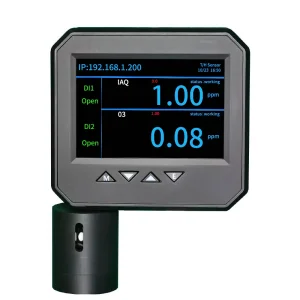
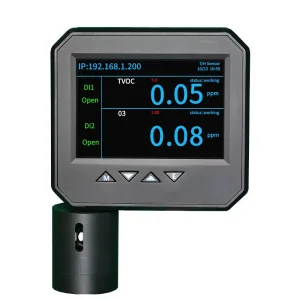
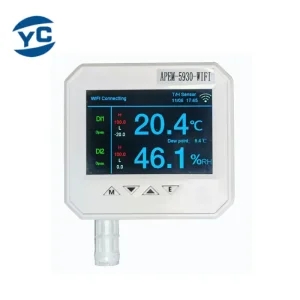
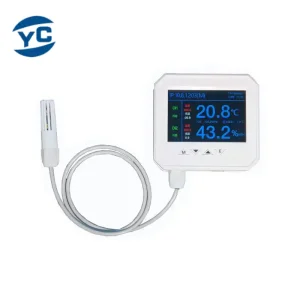
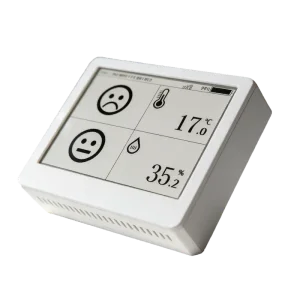
Active PoE circuits naturally generate heat as they convert 48V power. Standard sensors house the communication module and sensing chip in the same chamber, creating false temperature readings. YCLISensors structures the internal PCB to isolate the PoE power converter from the sensing chamber, using physical air barriers, slot vents, and option-extended external probes (as seen in the APEM-5930E) to guarantee +/- 0.3°C temperature accuracy.
To prevent sensor degradation in harsh settings (such as factories exposed to volatile gases or high humidity levels), our sensors utilize high-grade calibration modules imported from Switzerland and Germany. These elements maintain calibration long-term, resisting cross-sensitivity to standard pollutants and industrial solvents.
YCLISensors devices are designed for immediate software integration. Our PoE modules natively support industrial protocols including Modbus TCP, SNMP v1/v2c/v3, MQTT for cloud telemetry, and a lightweight JSON-over-HTTP API. This enables direct integration into platform systems like Zabbix, PRTG, Azure IoT, or legacy PLC monitoring frameworks.
Beijing Yingchuanglihe established. Developed its initial intelligent environmental monitoring terminal utilizing TCP/IP protocols alongside our proprietary monitoring software platform.
Collaborated with Switzerland's COMLAB to develop protective Ethernet sensors for the Beijing-Kowloon and Wuhan-Guangzhou high-speed railways. Co-developed the APEM-6100 with Founder Technology, introducing early PoE integration.
Partnered with Baidu to engineer and deploy the APEM-5900 intelligent Ethernet sensing array throughout Baidu's Yangquan Data Center, optimizing overall PUE efficiency.
Expanded into municipal infrastructure, providing vehicle-to-everything (V2X) edge gateways for Beijing autonomous driving road test stations and core infrastructure monitoring panels.
Established joint business divisions with Beijing Enterprises Water Group for smart pipeline network monitoring. Secured licensed Internet Data Center (IDC) operations qualifications.
For international supply chain managers, procurement engineers, and system integrators, securing the right PoE sensor partner goes beyond comparing hardware datasheets. Procurement teams face a range of common challenges: ensuring continuous stock availability, verifying certificates for global customs clearance, and finding partners capable of modifying firmware to meet specific security configurations.
At YCLISensors, we address these procurement priorities through structured OEM/ODM services and transparent manufacturing processes:
YCLISensors' multi-parameter PoE and Ethernet sensors are deployed across diverse sectors, serving as critical infrastructure components:
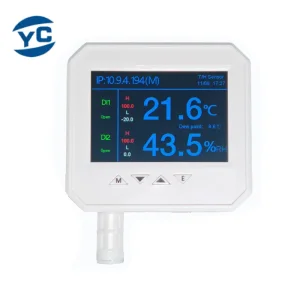
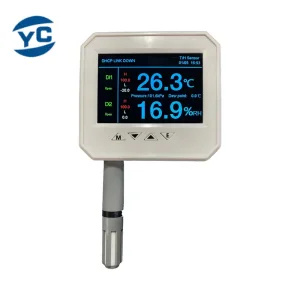
Thermal stability is crucial for modern server halls. Fluctuations in temperature can cause hardware failure, while excessive air dry-out increases electrostatic risks. Using the APEM-5930P (measuring temperature, relative humidity, dew point, and air pressure differential), data centers can monitor and optimize micro-climate metrics, manage under-floor plenum pressure, and reduce PUE cooling costs.
In sterile manufacturing, pressure differentials prevent contaminated air from entering clean zones. The APEM sensor family offers high-resolution atmospheric monitoring to track differential air pressure. This helps operators identify ventilation failures before they compromise pharmaceutical production runs.
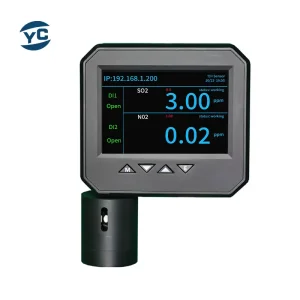
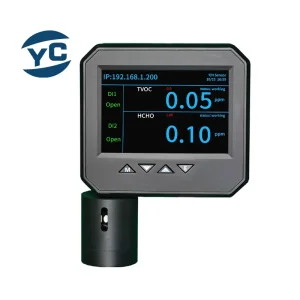
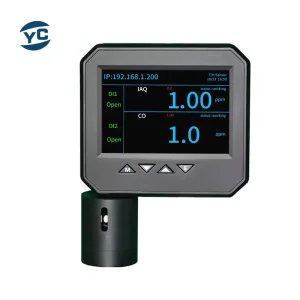
Underground utilities, sewer networks, and high-voltage cable channels face gas buildup risks, including toxic hydrogen sulfide (H₂S) or explosive gas combinations. Implementing the APEM-5930G-O₂-H₂S sensor provides continuous monitoring for utility tunnels, helping protect municipal workers and city infrastructure.
As industrial automation shifts from reactive alerting to proactive anomaly prevention, YCLISensors is integrating advanced technologies into our future product roadmap. We are focused on three primary areas of innovation:
Electro-chemical gas sensors degrade over time due to ambient exposure, requiring regular manual recalibration. YCLISensors is developing edge-computing modules that run predictive drift correction algorithms. These modules use historical trends to self-calibrate, extending maintenance intervals and reducing manual calibration visits.
We are expanding our hybrid product portfolio, combining wired Ethernet configurations with long-range low-power radio communication (such as the APEM-5736 LoRa series). If a core network switch fails, the sensors automatically switch to a secure LoRaWAN mesh network, protecting data collection in mission-critical applications.
Through our collaboration with the Beijing University of Civil Engineering and Architecture, we are integrating environmental data with centimeter-level Beidou positioning. This is designed for structural monitoring applications, mapping environmental factors directly against physical ground shifts or pipeline changes.
Our Swiss-engineered temperature and relative humidity sensors are rated for minimal drift, typically requiring recalibration every 24 to 36 months under standard conditions. Specialized electrochemical gas modules, such as our SO₂ or CO sensors, should be checked annually using standard span gases to maintain peak measurement accuracy.
Self-heating is prevented through physical board separation. The PoE power regulation chips are mounted on a isolated section of the PCB away from the sensor elements. Ventilation paths guide ambient air directly across the sensor module, or operators can select extended external probes (e.g., APEM-5930E) to isolate the sensing element from the main enclosure.
Yes. Our sensors operate as open-protocol network devices. Out of the box, they support Modbus TCP and SNMP (v1/v2c/v3) for SCADA networks, alongside MQTT and JSON/HTTP APIs for direct integration into cloud management and third-party monitoring platforms.
 YCLH Sensor