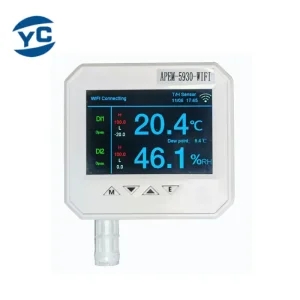
High-reliability temperature, humidity, and dual-mode Ethernet/LoRa network systems.
Beijing Yingchuanglihe Electronic Technology Co., Ltd. delivers global-grade reliability backed by 18+ years of technical field deployment.
By using imported microchips from Switzerland and Germany, we guarantee long-term stability and high-accuracy telemetry, keeping drift down to minimal thresholds even under critical environments.
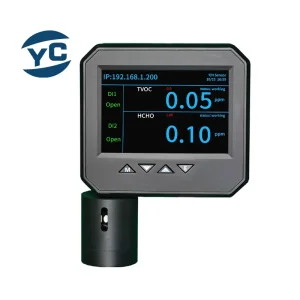
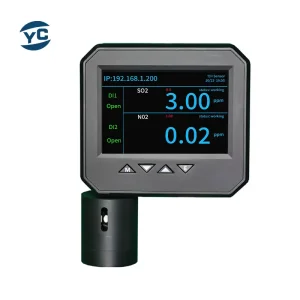
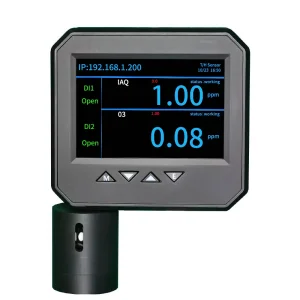
Whether you require physical restructuring for 19" chassis slots, special Ethernet Modbus TCP/IP registers, or unique gas sensing options (CO, O3, TVOC), our R&D team implements design turnarounds efficiently.
Our complete line of products carries active CE, FCC, and RoHS certifications. Combined with five automated assembly lines, we can scale supply constraints and satisfy large-volume orders on schedule.
Under the Google EEAT Guideline Framework, this guide analyzes why high-density AI clusters demand micro-climate monitoring.
Over the past decade, cloud service hubs and edge networks have migrated from general server-room environmental monitoring down to isolated micro-climate tracking at the 19-inch rack level. As AI processing cores and GPU arrays push rack thermal loads past 20kW, typical broad ambient sensing is no longer sufficient. High-density servers require localized, slot-by-slot tracking of critical inlet temperature, hot-aisle exhaust, and localized relative humidity (RH).
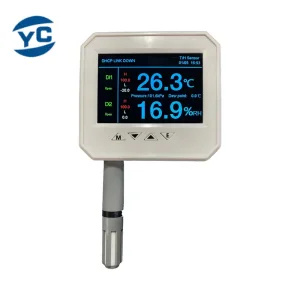
Modern 19-inch racks house complex configurations where hot and cold air paths can mix, creating high-risk microclimates. Uncontrolled temperature gradients trigger immediate throttling of GPU/CPU systems. Furthermore, unexpected swings in relative humidity introduce condensation hazards near server mainboards or electro-static discharges (ESD) in overly dry environments. Our 19-inch rack temperature transmitters address these challenges through sub-second digital updates, PoE interfaces, and Modbus-TCP communication protocols.
A primary failure mode in data center environmental logging is temperature/humidity sensor drift caused by constant, hot airflow from neighboring high-performance switchboards. To address this, Yingchuanglihe integrates MEMS-based semiconductor sensing modules sourced from industry-leading microchip foundries in Switzerland and Germany. These high-precision chips feature advanced chemical barriers over their moisture-sensitive polymer layers, shielding them from ambient volatile pollutants like TVOCs and dust accumulation.
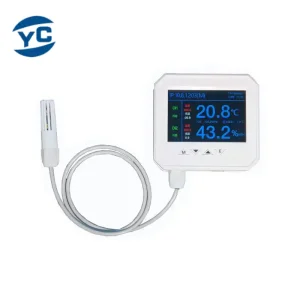
Equally critical is isolating internal transmitter circuit heat from skewing actual environment data. In typical designs, PoE power modules draw up to 5W, generating localized heat that impacts nearby sensing elements. Our engineers resolve this in the APEM-5930E and APEM-5930P series by separating the high-precision sensor probe from the main network module via an isolated, shielded cable extension. This keeps high-density electronics insulated while maintaining ultra-high reading accuracy for temperature and dew-point levels.
Procurement directors and infrastructure operators must navigate complex regional challenges when implementing enterprise environmental monitoring systems. A successful procurement strategy depends on several essential criteria:
In municipal utilities, smart cities, and autonomous test applications, environmental transmitters face harsh external conditions. For example, during Beijing's autonomous road trials, Yingchuanglihe designed and integrated custom multi-parameter gateway systems into roadside edge boxes. These advanced systems monitored real-time air quality, chemical pollutant levels, and high-frequency vibrations under extreme outdoor conditions. Similarly, in major high-speed rail projects, our customized protective Ethernet environmental sensors have been deployed alongside railway communication systems, providing reliable data under heavy electrical interference.
Nearly two decades of innovation and trusted industry partnerships.
Every device is designed and manufactured to meet global compliance, safety, and reliability standards.
Our dedicated engineering support team provides responses to technical inquiries within 8 hours, offering comprehensive integration assistance, Modbus register mapping, and deployment troubleshooting.
Every single environmental sensor undergoes a rigorous calibration process inside our controlled environmental chambers. This guarantees certified performance in temperature, humidity, and barometric pressure before shipping.
All our environmental monitors and transmitters carry certified CE, FCC, and RoHS compliance labels, ensuring quick and straightforward customs processing and regulatory acceptance in major global markets.
Detailed technical answers to common integration, calibration, and power deployment questions.
Explore our full line of professional environmental transmitters, data loggers, and multi-parameter gateways.
 YCLH Sensor